
IRS Penalties Explained Without the Jargon
IRS penalties have a way of sounding worse than they are, mostly because they’re written in a dialect that seems designed to raise blood pressure. You don’t need a law degree or a background in accounting to understand them, even though the letters might suggest otherwise.
This article breaks down IRS penalties in straightforward terms, without jargon, without scare tactics, and without pretending this stuff should be obvious. If you’re dealing with back taxes or an IRS notice, the goal here is clarity, not correction.
What IRS Penalties Really Are
IRS penalties are financial add-ons triggered by missed deadlines, missing paperwork, or unpaid tax balances. They are administrative, not personal. No one at the IRS is making a character assessment based on your return.
The system is rule-based and largely automated. When certain boxes aren’t checked on time, penalties get applied. When time passes without resolution, those penalties keep accumulating.
That’s it. No drama required.
The Most Common IRS Penalties, Explained
Here are the penalties taxpayers with back taxes run into most often, translated into normal language.
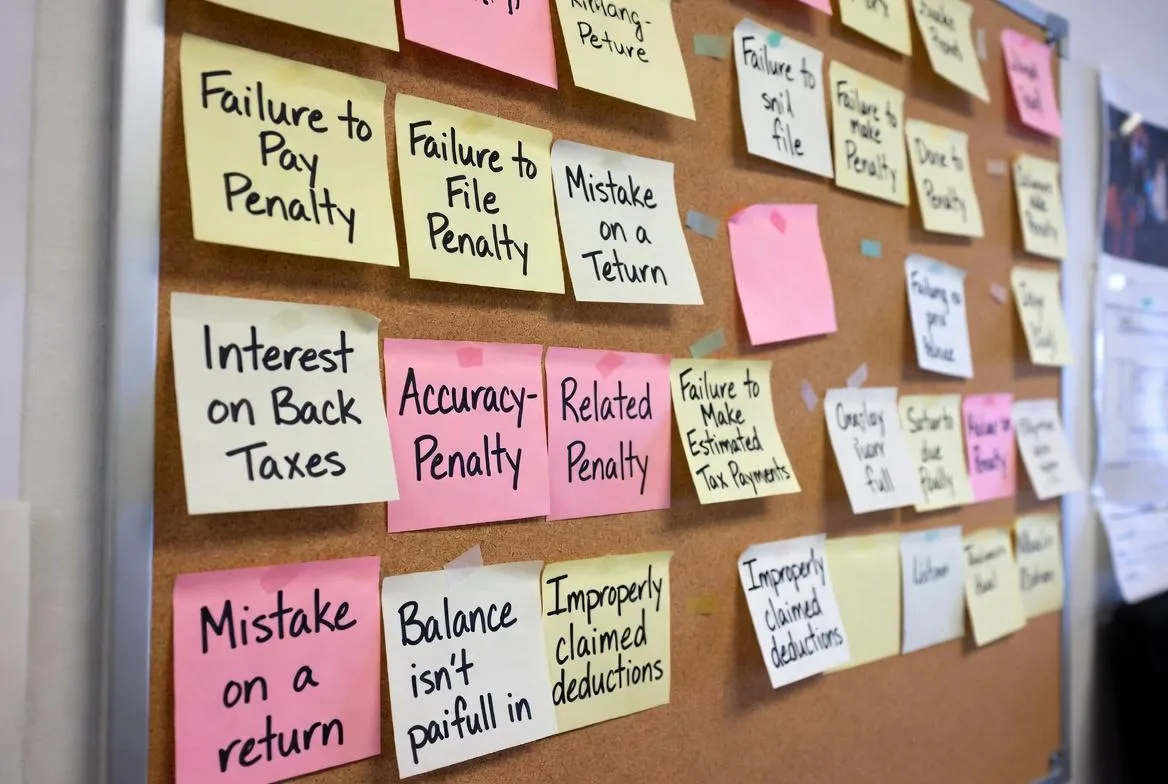
01. Failure to File Penalty
This penalty applies when a tax return isn’t filed by the deadline.
It’s calculated as a percentage of the unpaid tax for each month the return is late, up to a cap. This is one of the fastest-growing penalties, which is why unfiled returns can spiral quickly.
In practical terms, filing late but filing at all usually limits the damage far more than waiting.
02. Failure to Pay Penalty
This penalty kicks in when a return is filed but the balance due isn’t paid in full.
The monthly rate is lower than the failure to file penalty, but it still compounds over time. Many people assume that not filing buys breathing room. In reality, filing often slows the financial bleeding, even if payment isn’t possible yet.
The IRS prioritizes information before money.
03. Interest on Back Taxes
Interest accrues on unpaid taxes and on penalties that have already been added.
Interest isn’t technically labeled as a penalty, but it behaves like one. This is why balances can grow even when nothing new seems to be happening.
Time alone is enough to increase what’s owed.
04. Accuracy-Related Penalty
This penalty applies when the IRS believes there was a significant mistake on a return, such as underreported income or improperly claimed deductions.
This does not automatically imply fraud. These penalties frequently result from misunderstood rules, incomplete records, or reliance on bad information.
Intent matters less than the numbers.
05. Failure to Make Estimated Tax Payments
If you’re required to make quarterly estimated payments and don’t, the IRS may assess a penalty even if you eventually pay the full tax amount when filing.
Self-employed taxpayers, contractors, and freelancers see this one often.
Waiting until April works for withholding employees. It’s a different system for everyone else.

Why IRS Penalties Feel So Intimidating
IRS penalties are written to enforce compliance, not to explain context. The language is formal, rigid, and completely indifferent to how stressful it sounds.
That tone creates the impression that penalties are judgments. They aren’t. They’re formulas applied to dates and balances.
Understanding that distinction changes how you respond. Panic leads to avoidance. Clarity leads to options.
Can IRS Penalties Be Reduced Or Even Removed?
Often, yes.
The IRS allows penalty relief in specific situations, including reasonable cause and first-time penalty abatement. These are established parts of the tax code, not special favors.
The challenge is knowing whether you qualify and how to request relief correctly. That’s where most people get stuck, not because relief is rare, but because the process isn’t explained well.
As technology continues to influence the future of back tax resolution, smarter systems are making it easier to identify penalty relief opportunities earlier, before balances grow unnecessarily. The trend is toward better visibility, not more complexity.
What Happens If Penalties Are Ignored
Penalties themselves don’t trigger wage garnishments or bank levies. Unresolved back tax balances do.
Penalties increase the balance. Larger balances attract collection attention. Collections escalate when there’s no response. It’s a sequence, not a single leap.
Understanding penalties early gives you leverage. Waiting gives the system momentum.
If IRS penalties are part of your back tax situation, it doesn’t mean anything more than this: something went unaddressed, and now it needs structure.
A smarter next step is to get clear on where you actually stand. That means identifying which penalties apply, confirming what the IRS is responding to, and understanding what options are realistically on the table.
If you want help on that, a FREE CONSULTATION with our Back-Tax Relief Service can help you map out the situation without pressure or assumptions. It’s simply a way to confirm the risks, and see what makes sense before anything escalates - CLICK HERE
Calm steps, taken in the right order, tend to work far better than reacting to the tone of an IRS letter.




